Why Commercial Water Damage Is a Different Problem
A burst pipe or roof leak in an office, retail space, warehouse, or multifamily building rarely stays contained to one room the way it might in a house. Commercial buildings often have larger open floor plates, shared HVAC systems, and multiple tenants, all of which can spread water damage further and faster if the response isn't sized to match.
Downtime is also a direct cost for a business in a way it isn't for a homeowner, so scheduling and phased access to affected areas are usually part of the conversation from the first call.
Common Sources of Commercial Water Damage
Roof Systems and Flat-Roof Drainage
Many commercial buildings use flat or low-slope roofing with internal or scupper drains, which can back up during heavy rain or after hail damage compromises the roofing membrane, a real concern given Aurora's position in Hail Alley.
Fire Suppression System Discharge
Sprinkler system activation, whether from an actual fire or an accidental discharge, can release a large volume of water across a wide area very quickly, often affecting ceiling tiles, flooring, and equipment below.
Plumbing and Mechanical Room Failures
Commercial properties often have larger mechanical systems, water heaters, and supply lines than a home, and a failure in a mechanical room can go unnoticed longer if it's in a less-trafficked part of the building.
The Commercial Restoration Process
Rapid Assessment and Scoping
An initial walkthrough identifies affected areas, business-critical systems, and any safety concerns, since commercial spaces often need coordination with building management or multiple tenants before work begins.
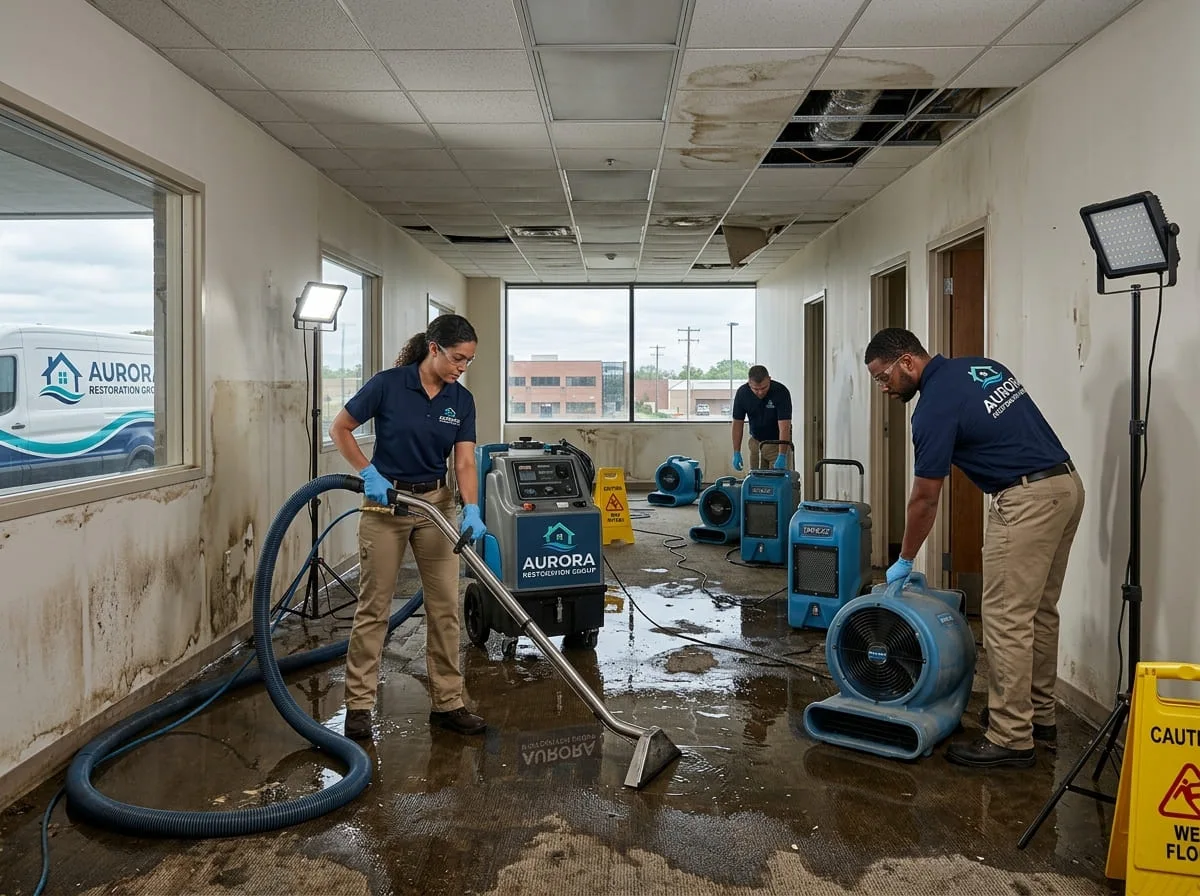
Large-Scale Extraction and Drying
Equipment is scaled to the space, which may mean multiple truck-mounted extraction units and a larger number of air movers and dehumidifiers than a typical residential job. See water extraction and water removal for how the equipment itself works.
Phased Work to Limit Business Disruption
Where possible, work is phased so unaffected areas of a business can continue operating while restoration proceeds in the affected sections, rather than closing an entire property for the full duration.
Documentation for Commercial Claims
Commercial insurance claims often involve business interruption coverage in addition to property damage, so thorough documentation, moisture readings, photos, and a detailed scope of work, matters even more than on a typical residential claim. Insurance claim assistance is available through the receiving restoration contractor.
Serving Aurora's Commercial Corridors
Commercial water damage response covers properties throughout Aurora and into neighboring Denver and Centennial, from retail and office space to multifamily and light-industrial buildings. If contamination is involved, such as a backed-up drain line, see sewage cleanup for how that situation is handled specifically.
Types of Commercial Water Loss Events
Multi-Tenant Buildings
In a building with several tenants, a single water event, such as a burst supply line on an upper floor, can affect multiple units below it, which requires coordinating access and cleanup across more than one leased space.
Retail and Customer-Facing Spaces
Retail locations often need to balance restoration work with continued customer access, so containment barriers and phased scheduling are used more heavily than in a space that can simply close for the day.
Warehouse and Light-Industrial Space
Larger open floor plates in warehouse or light-industrial buildings can mean water spreads across a wide area before it's discovered, particularly in sections not regularly staffed, making equipment scale and thorough moisture mapping especially important.
Working With Facilities and Property Managers
On larger commercial properties, the restoration contractor typically works directly with the facilities or property management team to coordinate access, communicate with affected tenants, and schedule work around business operations wherever possible.
Minimizing Business Interruption
Beyond the physical cleanup, a priority for commercial clients is getting back to normal operations as quickly as responsible drying allows. That can mean running equipment overnight, sectioning off only the directly affected area, or sequencing work so the highest-priority spaces are addressed first.
Commercial Sewage and Contaminated Water Events
A commercial sewage backup or other contaminated water event requires the same containment and material removal approach used residentially, just scaled to a larger footprint and often more fixtures feeding into the affected system. See sewage cleanup for that process in more detail.
Insurance Documentation for Commercial Property Owners
Commercial policies and lease agreements can assign responsibility for water damage differently than a typical homeowners policy, particularly in multi-tenant buildings. Detailed documentation from the outset helps clarify scope and supports whichever party is ultimately responsible for the claim.
Commercial Properties Near Aurora's Business Corridors
Commercial water damage response covers office and retail corridors throughout Aurora and neighboring Denver and Centennial, including properties near the Fitzsimons area and along major commercial corridors where a mix of older and newer commercial construction is common.
After-Hours Commercial Response
A pipe failure or sprinkler discharge that happens overnight or over a weekend, when a business is unstaffed, can go unnoticed longer than a daytime event, sometimes resulting in more extensive damage by the time it's discovered. Emergency dispatch is available around the clock specifically because commercial water events don't wait for regular business hours any more than residential ones do.
Coordinating With Insurance Adjusters and Vendors
Larger commercial claims often involve an insurance adjuster, sometimes a public adjuster, and occasionally other vendors like a general contractor for structural repairs. Clear documentation from the restoration contractor helps keep everyone working from the same information about scope and cause.
Frequently Asked Questions
Can a business stay open during commercial water damage restoration?+
Often, at least partially. Work is frequently phased so unaffected areas can keep operating while extraction and drying proceed in the affected section, though the extent of the damage determines how much of the space can remain in use.
How is equipment scaled for a larger commercial building?+
Larger jobs typically use more air movers and dehumidifiers, and may involve multiple truck-mounted extraction units running at once, sized to the square footage and severity of the water event rather than a one-size-fits-all setup.
Does commercial water damage restoration include documentation for business interruption claims?+
Thorough documentation, including photos, moisture readings, and a written scope of work, is standard practice and supports both property damage and business interruption claims. Insurance claim assistance is available through the receiving restoration contractor.
What commercial property types are typically served?+
Office buildings, retail spaces, multifamily properties, and light-industrial or warehouse buildings are all common commercial water damage calls, each with different access, shut-off, and equipment considerations.
Who coordinates with building management or multiple tenants during a commercial job?+
The responding restoration contractor typically coordinates directly with property management or designated points of contact to manage access, scheduling, and communication across affected tenants.