
The Short, Honest Answer
Mold growth requires moisture, an organic food source (which includes drywall paper, wood, and dust), and time. Under warm, humid conditions with materials left wet, some mold species can begin to establish within roughly 24 to 48 hours. Under drier conditions or with prompt professional drying, that window can be considerably longer, or the risk can be avoided altogether.
The commonly repeated 48-hour figure is a reasonable rule of thumb for why fast response matters, not a guarantee that mold will or won't appear on a fixed schedule. Every situation is different, and this article stays factual rather than alarmist about what that actually means.
What Actually Drives Mold Risk
How Long Materials Stay Wet
The single biggest factor is how long materials remain saturated, not just whether they got wet. A wall that's extracted and dried within a day carries meaningfully less risk than one left wet for a week, regardless of the original water source.
Humidity and Airflow in the Space
Enclosed, poorly ventilated areas — a closed-up basement, for example — hold humidity longer than a room with good air exchange, which extends the window during which mold-supporting conditions exist even after the original water source is stopped.
Water Category
Water that's already contaminated, as covered in our guide to water damage categories, can introduce organic material and bacteria that accelerate conditions favorable to mold compared to clean water.
Why Aurora's Climate Cuts Both Ways
Aurora's semi-arid, low-humidity outdoor climate is generally favorable for drying once affected areas are opened up and ventilated. But that same climate doesn't protect enclosed, unventilated spaces like basements, which are common across nearly every era of Aurora's housing stock and can hold trapped moisture regardless of how dry it is outside.
Where Mold Tends to Develop First
Enclosed, Low-Airflow Spaces
Closets, cabinet interiors, and basements typically develop conditions favorable to mold faster than open rooms with good air circulation, simply because humidity has fewer ways to dissipate.
Behind Baseboards and Under Flooring
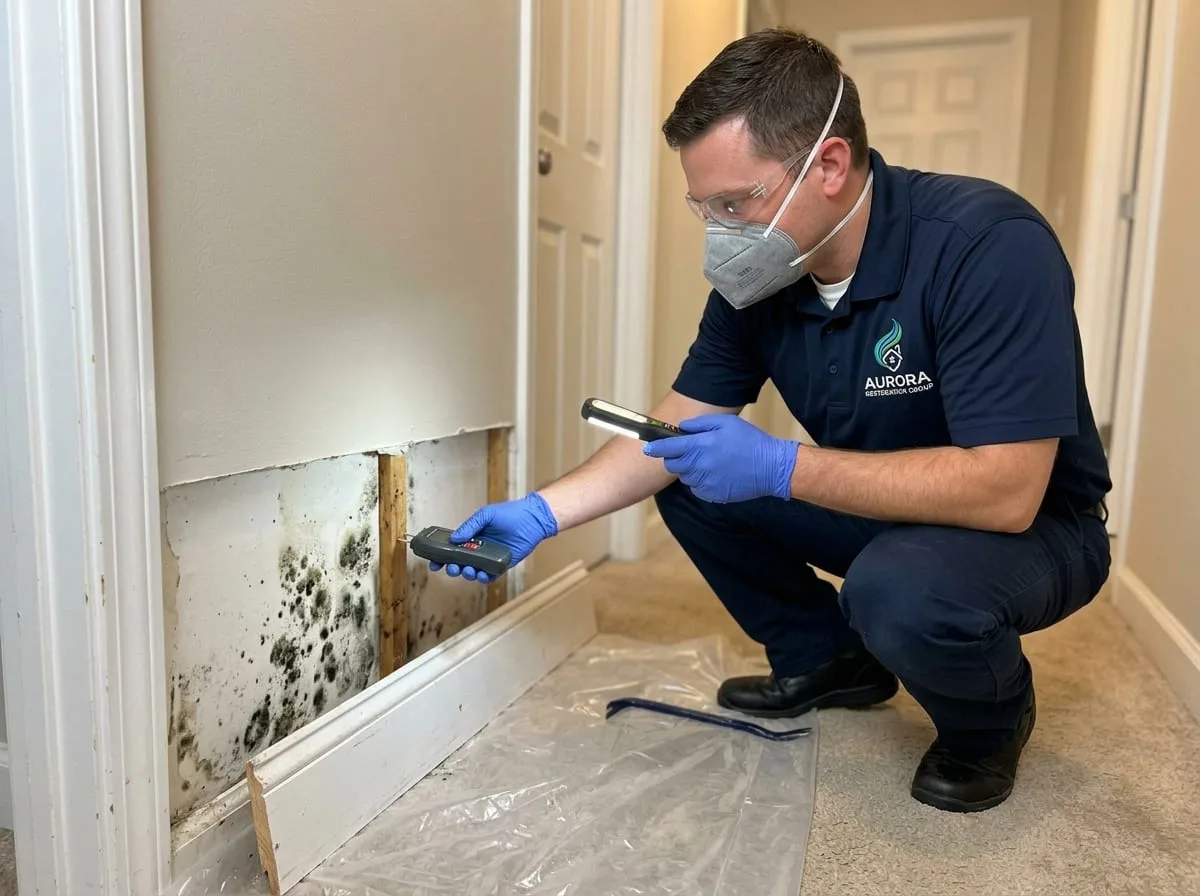
Areas that stay damp longest because they're hidden from view — behind baseboards, under carpet padding, beneath vinyl flooring — are common early development sites precisely because they're the last places anyone checks without specific tools.
Around HVAC and Plumbing Penetrations
Spots where pipes or ductwork pass through walls or floors can trap residual moisture even after the surrounding area has dried, making them worth a specific check after any significant water event.
Signs Moisture May Already Be a Problem
- A persistent musty odor in a room, closet, or basement area, even without visible staining.
- Discoloration on drywall, baseboards, or ceiling tiles that wasn't there before a known water event.
- A previous leak or flood that was cleaned up on the surface but never professionally dried or moisture-checked.
- Condensation or dampness recurring in the same spot without an obvious active leak.
What Reduces the Risk
Fast Extraction and Drying
The most effective way to reduce mold risk after water damage is straightforward: get water extracted and materials drying as soon as possible. Our guide on how long water damage takes to dry covers what actually determines that timeline.
Verifying Materials Are Actually Dry
Surface-dry isn't the same as fully dry. Moisture meters confirm materials have reached a stable, dry range rather than just looking dry, which is why professional drying processes include monitoring rather than stopping equipment based on appearance.
Checking Hidden Areas, Not Just Visible Ones
Moisture trapped behind walls or under flooring won't be caught by a visual check alone. Our article on how professionals find hidden moisture behind walls explains the tools used to catch what isn't visible.
How Recurring Moisture Differs From a One-Time Event
A Single Fast-Resolved Leak
A one-time leak that's extracted and dried promptly, with readings confirmed back to a normal baseline, generally carries the lowest ongoing mold risk of any water event, since the conditions mold needs never really had time to establish.
Recurring or Chronic Moisture
A slow, repeated leak, chronic condensation, or a basement that dampens every time it rains presents a different risk profile than a single event, since materials are never given the chance to fully dry between exposures. This kind of recurring moisture is more often associated with mold development than an isolated, well-managed incident.
Why Aurora Homes See This Pattern With Basements
Because unfinished and finished basements alike are common across nearly every era of Aurora's housing stock, and because these spaces have naturally lower airflow than upper floors, basements are a common site for the kind of low-grade, recurring moisture exposure that raises mold risk over time — separate from and in addition to acute events like a burst pipe or storm-driven flooding.
What Happens If Mold Is Already Present
If mold has already developed, the appropriate response is inspection, testing where warranted, and remediation performed to recognized industry standards — including containment to prevent spreading spores to unaffected areas, removal of affected materials, and post-remediation verification. This is a factual, procedural process rather than something to approach with alarm. The mold remediation and mold after water damage pages cover what that process typically involves.
A Note on Health Claims
Mold can be an allergen and respiratory irritant for some people, and general population studies note associations with respiratory symptoms in damp environments. Beyond that general, well-established point, this article avoids more specific health claims, since individual sensitivity varies and specific medical guidance should come from a healthcare provider, not a restoration website.
What General Testing and Inspection Involve
Visual Inspection First
Most assessments start with a visual inspection, checking areas with a known history of moisture, visible discoloration, or reported odor, along with a general review of ventilation and any past water events in the property.
Sampling When It's Warranted
Air sampling and surface sampling can be used to help characterize a situation, generally when visual inspection alone doesn't give a clear enough picture, or when documentation is needed before or after remediation work. What sampling is appropriate depends on the specific situation and is determined by the professionals conducting the assessment.
Post-Remediation Verification
After remediation work is complete, a follow-up check confirms the work was effective before an area is considered clear. This step exists specifically so that remediation isn't just assumed to have worked based on visual appearance alone.
A Realistic Timeline for Getting Ahead of the Problem
If a leak or flood just happened, the practical timeline looks like this: extract standing water as soon as possible, begin monitored drying within the same day if feasible, and have the space checked with moisture meters over the following days until readings confirm a return to normal. Handled this way, most water events never progress to a point where mold becomes a real concern at all.
The Bottom Line
Mold risk after water damage is real but manageable, and it scales directly with how quickly water is extracted and materials are properly dried and verified. Treating water damage as urgent — rather than waiting to see what happens — is the most effective thing a homeowner can control.
None of this requires guessing. Moisture meters, thermal imaging, and a documented drying process take the uncertainty out of the equation, replacing it with readings that show whether a space is actually recovering as expected. That's the difference between hoping a wet space dries out fine and confirming that it did.
What to Do if You Suspect a Past Leak Was Never Fully Dried
If you're moving into a home with an unclear water damage history, or you recall a past leak that seemed to resolve on its own without professional drying, it's reasonable to have the area checked rather than assume everything is fine. A moisture check of previously affected areas is a straightforward, non-invasive way to rule out lingering problems before they show up as a bigger issue.
Frequently Asked Questions
Is it true that mold always grows within 48 hours of water damage?+
48 hours is a commonly cited reference point for why fast drying matters, but it isn't a guarantee. Actual timing depends on humidity, temperature, material type, and how long materials stay wet, and can be longer or, in warm humid conditions, potentially faster.
Can I prevent mold just by drying visible water quickly?+
Drying visible water quickly helps significantly, but moisture that's traveled into wall cavities, under flooring, or into insulation also needs to be addressed. That's why professional moisture mapping matters alongside surface cleanup.
Does a musty smell always mean there's mold?+
A musty odor is a common early indicator of trapped moisture or developing microbial growth, but it isn't a diagnosis on its own. It's a reasonable signal to have the area professionally checked rather than something to assume the worst about.
Is mold from water damage dangerous to my health?+
Mold can be an allergen and respiratory irritant for some people, particularly those with existing sensitivities, but individual risk varies. Specific health concerns are best directed to a healthcare provider rather than assessed from general information.
How is mold testing typically done after water damage?+
Testing can include air sampling and surface sampling depending on the situation, generally used to help scope remediation and confirm results afterward. Specific methodology and thresholds should come from the professionals conducting the assessment for your property.